


In this week’s newsletter: The Stahl House is officially up for grabs. We also sat down with Micah Springut of Monumental Labs to talk robots, carved stone, and why buildings might have low self-esteem. Plus: our new favorite brutalist cafe and a few additions to our dream home moodboard.
NEW FINDS FOR THE COLLECTION

The clients for Kokako Heights House tented on site for over a year before enlisting the help of Arkhé to design their new home — a detail that tells you everything about the connection they wanted with this land. Built with passive design principles, the home was stripped back to its essentials: shelter from the elements, integration with its surroundings, and a direct pull toward the ocean views.

We’re digging KONCRETE, a brutalist cafe in Dubai that serves good coffee among rotating displays from select, design-forward brands. The space is the first of its kind in the UAE. Deliberately minimal, shell+core treats raw concrete as a blank canvas for whatever comes next. We’d hang out here.

A new addition for our dream home wishlist: this Pavilion in the Oaks, by Mork-Ulnes is a quiet counterpoint to an existing 1970s suburban home. Suspended in the treetops, it creates a split world for both wellness and escape, with a fitness room, sauna, and bath connected back to the main house by a canopy bridge.

We didn’t know we needed a backyard listening room until we spotted Hosono House, a project by Ryan Leidner Architecture that turns an awkward San Francisco plot into a quiet, minimal retreat.

Originally designed by Ray Kappe in 1973, Glass Ridge House has been reimagined by OWIU Design’s co-founders, Amanda Gunawan and Joel Wong, into their personal home and a kind of living thesis. Blending Eastern and Western design philosophies, the renovation feels deeply rooted in the California landscape while incorporating personal touches that make it unmistakably theirs.

It seems like everyone’s headed to Japan this winter. We have no shortage of incredible stays to recommend, but Hotel K5 keeps rising to the top of our list.
Set inside a converted 1920s bank building beside the Tokyo Stock Exchange, the hotel helped pull Nihonbashi Kabutochō into its new creative era.
For K5, Claesson Koivisto Rune leaned into Aimai, the Japanese idea of erasing boundaries, reimagining the space as a micro-complex of bars, eateries, and gathering spots where Swedish-minimalism-meets-Japanese-heritage.
If you book K5 with Linear Concierge, you’ll get exclusive member rates with VIP perks along the way. Request a booking, or reply to this email for our tailored recs for your destination.

This week, we’re talking to Micah Springut, Founder and CEO of Monumental Labs, about stone and how craft coexists with machines. Monumental is bringing carved stone back into everyday architecture, not as luxury flourish but as something technology can actually make more accessible.
What first drew you to stone as a medium?
I grew up in New York. My favorite buildings were covered in carved limestone. I couldn’t wrap my head around how you could shape stone the way they did.
What’s the most surprising emotion you’ve felt while working with machines?
Awe. Watching these robots work and seeing something emerge from stone is incredible. It’s an art form itself. I thought I would be bored of it by now.

If buildings could feel, what do you think they’d say about how we make them now?
I’m sure they’d have very low self esteem since it’s pretty rare that someone values them enough to make them beautiful or inspiring.
What’s a small detail you’ve noticed lately that reminds you of the importance of craft in architecture?
We were carving a pediment for Carnegie Hall to replace part of the original that had cracked off. We had the original relief in front of us to copy from. The depth and texture the original carver achieved were incredible, sharp undercuts and beautifully textured surfaces that were made with quick and violent chisel marks. He had to have utmost confidence to be able to do that. Must have spent a lifetime carving.
When you look at a city, what do you see that others might miss?
I look at stone facades of old buildings and see how often the stone blocks are mottled and inconsistent. Look at the Louvre, look at the Met. They get their texture from the natural variation of stone. Today, architects pay dearly to get stone that look consistent all over, but that means tossing out lots of usable stone and the facades usually look worse and less natural for it.
We met Micah on X. You can find him there, and learn more about what he and the team at Monumental Labs are up to on their website.
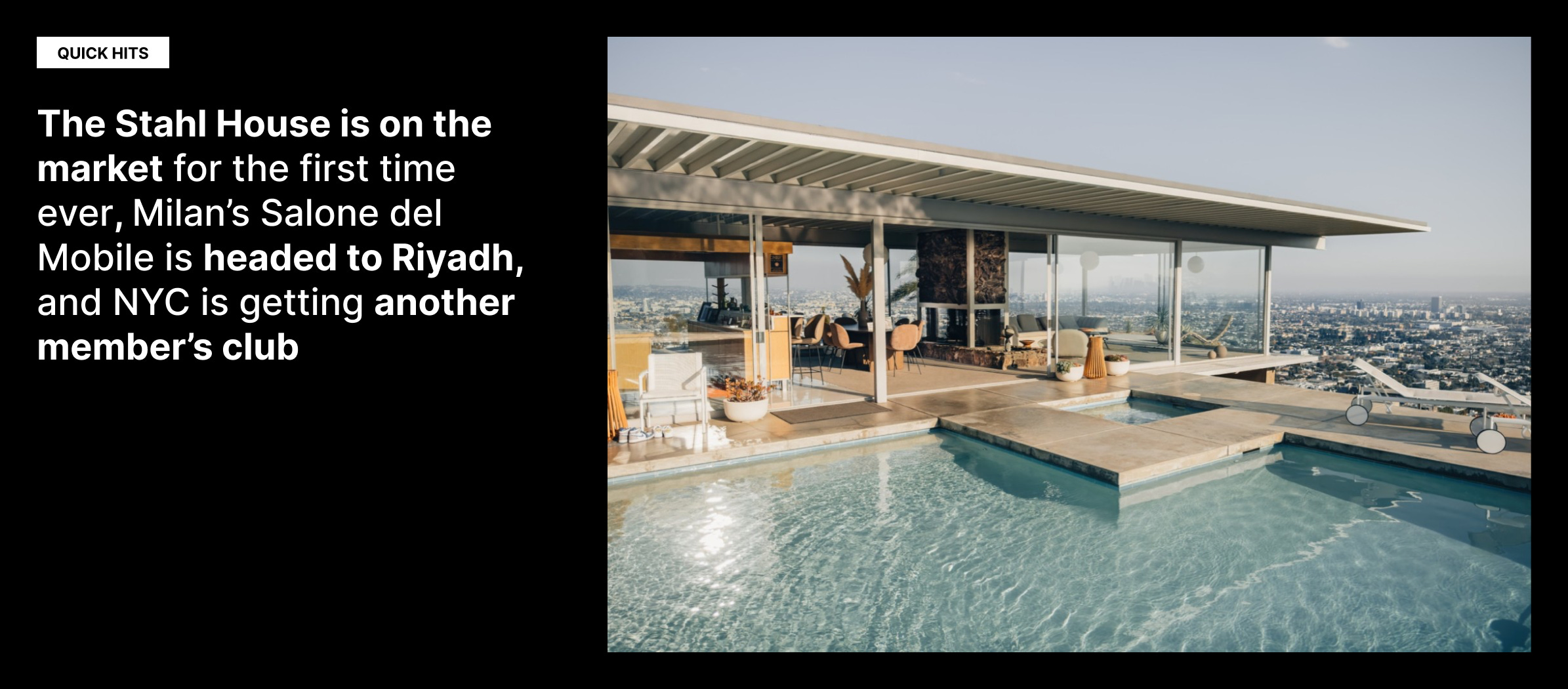
It’s a good time to be in the market for collectors’ homes:
Pierre Koenig‘s iconic Stahl House (aka Case Study #22) is for sale on the public market for the first time ever, fetching a price upwards of $25M. A defining icon of midcentury modernism, it’s one of the most photographed homes in the world and a near-mythic piece of Los Angeles architecture. We’re sending Hunter Owens to do a field report — if you find yourself on a tour, we want to hear what you think.
The Strick House, Oscar Niemeyer’s only residential project in the United States, is on the market for $12.9M (coming in just under our very real, very reasonable budget of $13M). With its sculptural curves and unmistakeable Brazilian modernist DNA, it’s a rare chance to own a piece of Niemeyer’s design legacy on American soil.
Pick yourself up a Rudolph Schindler House — the 1941 Druckman Residence is back on the market for $2.6M. Schindler listings at this price point are nearly unheard of, and this one captures the interlocking volumes and warm materiality that defined his most influential period.
In other news…
Design for your dentist: Josh Lipnik of Midwest Modern spotted a Phillipe Starck-designed toothbrush in the wild at a vintage furniture store in Ann Arbor, of all places. We found a few on eBay for $49. Condition unknown.
If you can’t beat ‘em, join ‘em: Milan’s Salone del Mobile announced plans to launch a satellite fair in Riyadh, another sign of the Middle East’s growing presence in global design. The Middle East has strong design voices of its own. The question is whether this kind of Western attention amplifies them, or flattens them. Either way, it’s a space worth watching.
Timberrrr: Construction has begun on the world’s largest freestanding mass-timber roof in Vancouver. Designed by Revery Architecture and slated for completion ahead of the 2026 FIFA World Cup, the structure will serve as the signature venue for the FIFA Fan Festival with capacity for 10,000 fans.
Keyed in: Michelin announced its latest Keys, and two of our longtime favorites made the list. Congrats to Inness and Hotel Saint Augustine on their shiny new awards. Both are part of our Concierge Collection, and bookable through Linear with member perks.
If everyone’s special, no one’s special: NYC is getting yet another new Members’ Club, which feels about right for this moment. Moss features a hammam, vinyl lounge, and pickleball court. Members’ clubs are multiplying fast — maybe too fast. We’re watching to see whether this boom leads to a mass-luxury plateau, or a return to small, intentional, actually-exclusive spaces.
We want to know what’s been on your mind lately. A design worth obsessing over? A new city we should explore?
Reply to this email, or comment below with your ideas, stories, or questions. We’ll turn them into the next Linear stories, interviews, itineraries, and dispatches for the Architecturally Curious.
Until next time, stay curious [—]