


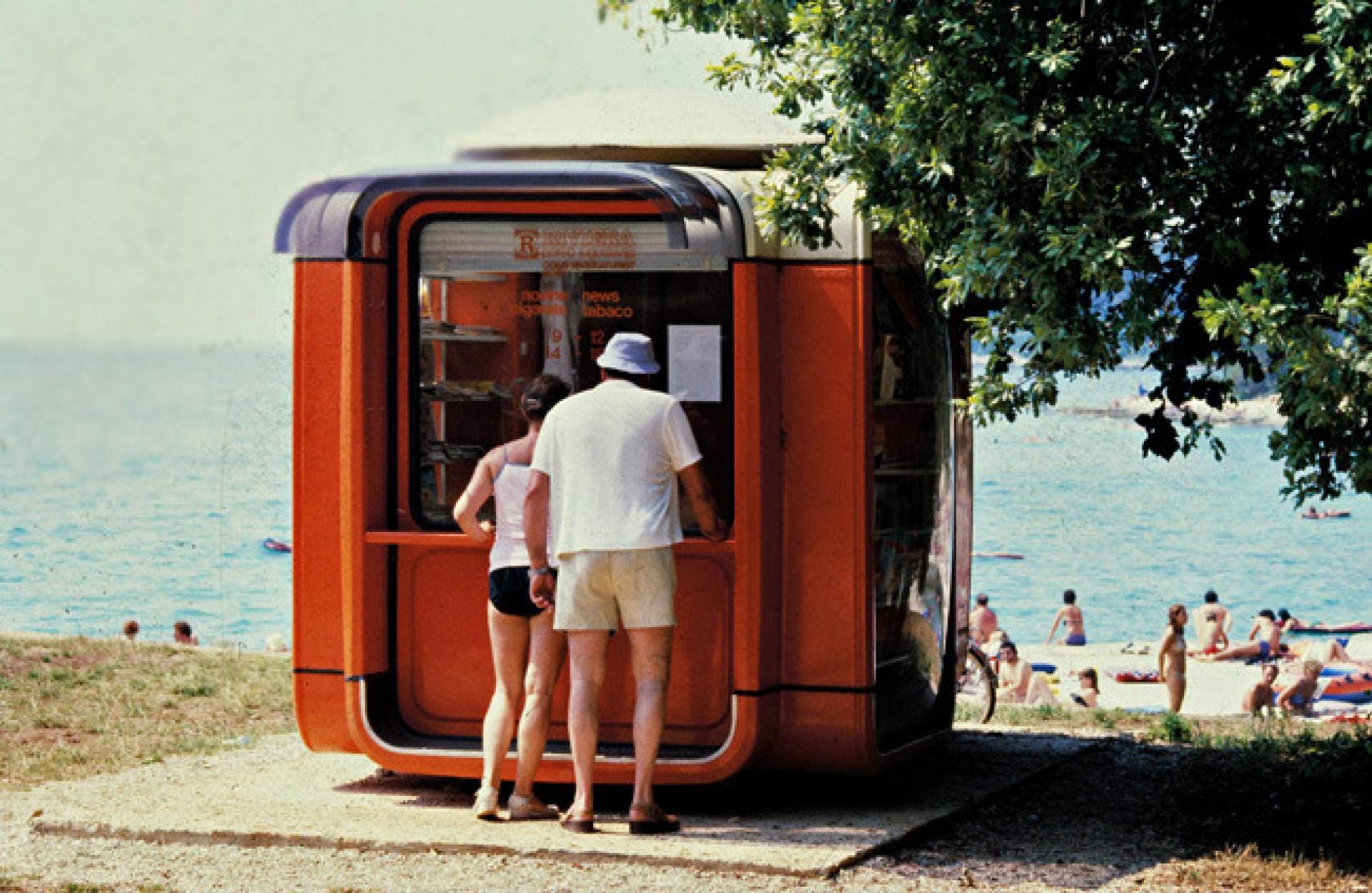
In 1966, Slovenian architect Saša J. Mächtig designed the K67, a prefabricated, modular kiosk that garnered international acclaim. Designed for everyday use, it could serve as a newsstand, flower shop, or snack bar (or, as The Lot Radio demonstrated in Times Square decades later, a DJ booth).
The K67 was a product of Yugoslavia’s particular modernity during the Cold War: socialist, but independent of Moscow and increasingly open to Western cultural and economic influences. Its playful, futuristic design was as much a product of this environment as its practical ambitions.

It’s also the primary reference for EJE Belgrade, a listening bar designed by Supaform that brings together a wonderfully unlikely collection of influences. Alongside the K67 are Japanese jazz kissas and ramen bars, the patterned moquette originally designed for the London Underground’s District Line, and a Japanese Dulton Double Face clock reminiscent of those found in railway stations and waiting rooms.

Together, they form what Supaform calls “a contemporary embassy of aesthetic pleasures.”

We spent a long weekend in Montréal recently scouting spots for the LINEAR city guide, and on the advice of our friends at Atelier L’Abri, were particularly excited to join the cool kids for a morning at FOIL Gallery. Founded by artists Frédéric Duquette (FVCKRENDER) and Jo-Anie Charland (Baeige), the gallery and café occupies a former Canadian munitions factory, thoughtfully restored by Atelier L’Abri themselves.
Between the rotating exhibitions, good coffee, Parc des Gorilles next door, and Jean-Talon Market a short walk away, you could easily spend a whole morning in the neighborhood. We were lucky to catch Sean Brown’s Curves pop-up. Currently on view is 50 Years, 50 Posters, an exhibition of Canadian graphic design curated by Bryan-K. Lamonde of Montréal-based Principal Studio, running through November 11.

For a city with as much going for it as Rome, we’ve always found its hotel scene a little underwhelming. Not that there aren’t exceptions — Jean Nouvel’s Rhinoceros is a favorite — but so many of the city’s hotels seem content to trade on old-world grandeur. Experimental Roma, with interiors by Rodolphe Parente, feels like a welcome change of pace.
The hotel occupies a former bank at 46 Via Ludovisi, just off Via Veneto, which, in the 1950s and ’60s, was the center of Rome’s international café society — a meeting place for Hollywood actors, Italian filmmakers, aristocrats, journalists, and photographers. Parente draws on the likes of Carlo Scarpa, Luigi Caccia Dominioni, and Gio Ponti, the latter of whom was immortalized in a series of 1927 frescoes depicting Rome’s artistic and social circles at the Grand Hotel Palace, just around the corner.
DESIGN A TRIP WITH LINEAR CONCIERGE. LINEAR-WORTHY STAYS, VIP PERKS, AND CURATED RECS FROM LOCALS WE TRUST. TELL US WHAT YOU’RE THINKING ABOUT →

Despite decades of international success, Joan Miró was 63 before he finally got the dedicated studio he’d always imagined for himself. In 1956, he turned to his longtime friend Josep Lluís Sert to design a studio in Palma, Mallorca, now part of Fundació Miró Mallorca. Sert was living in exile in the United States following the Spanish Civil War, so the two designed the studio largely through letters. Today, it remains much as Miró left it, filled with shells, stones, postcards, and curious objects he’d collected over the years.
But as Mallorca’s tourism boom transformed the surrounding landscape, the Mediterranean views Miró had fallen in love with began to disappear. When Rafael Moneo was later commissioned to design a museum for the foundation, he responded by turning the building inward, shielding it from the surrounding development and introducing pools of water, including one on the roof, in an attempt to bring back something of the lost Mediterranean horizon.