



Offices are starting to feel like home again. Not in the Zoom-background, scented-candle, ergonomic-chair kind of way, but architecturally. Zoned spaces. Softer light. Wood, velvet, steel. Actual rooms with doors that close, instead of the endless open sightlines that defined the last decade. Conversation pits that feel slightly impractical but deeply intentional.

I don’t think this is aesthetic drift, and it isn't designers getting bored of white walls. Rather, it’s a response to a genuine architectural problem: if productivity has been decoupled from place, what is the office actually for?
If you can do your job from a couch in Lisbon, or a coworking space that feels suspiciously geographically ambiguous, what gives? You can spin up an app in a weekend, draft a strategy memo with AI, collaborate in the same document from three continents. The office can’t just be a machine for productivity anymore. It has to justify itself in a deeper way.
We've actually seen this movie before. Coming out of the industrial era in the 1960s and '70s, offices began to soften in ways that now get flattened into Mad Men nostalgia — wood paneling, low sofas, rooms that felt more like salons than production lines.
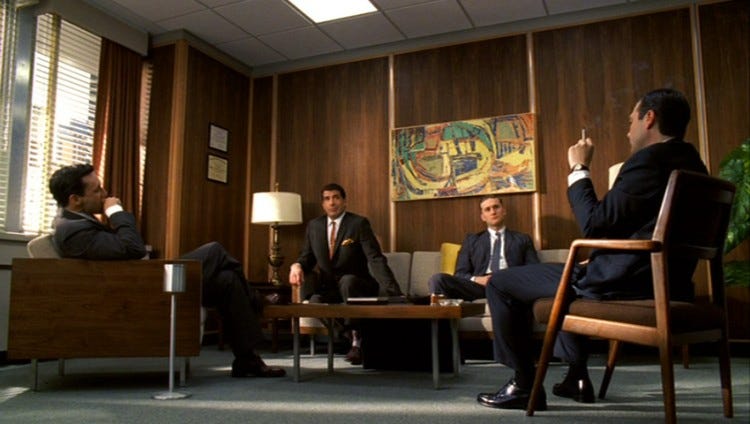
That shift wasn't random, and it wasn't just for the vibes. In 1964, Herman Miller designer Robert Propst published a research manifesto arguing that the office should be, in his words, "a mind-oriented living space." The furniture system he developed with George Nelson, the Action Office, gave workers standing desks, moveable surfaces, and the ability to shift posture and mode throughout the day. It was a spatial argument that thinking work deserved a thinking environment.
Around the same time in Germany, the Quickborner consulting team was designing what they called Bürolandschaft — office landscapes — replacing regimented rows of desks with organic, curving arrangements, plants, and informal clusters. The first one, built for a Bertelsmann publishing house in 1960, was described by its designers as creating "intimacy" within a large floor. Two very different approaches, but the same underlying conviction: the factory model had optimized the wrong thing, and space could say so.
The 2010s had their own spatial ideology. Open floor plans, converted warehouses, glass-walled meeting rooms suspended over triple-height atriums. Facebook's Menlo Park campus, designed by Gehry, stretched a single floor across nearly ten acres, one of the world's largest open floor plans, a spatial manifestation of the company's "move fast" philosophy.
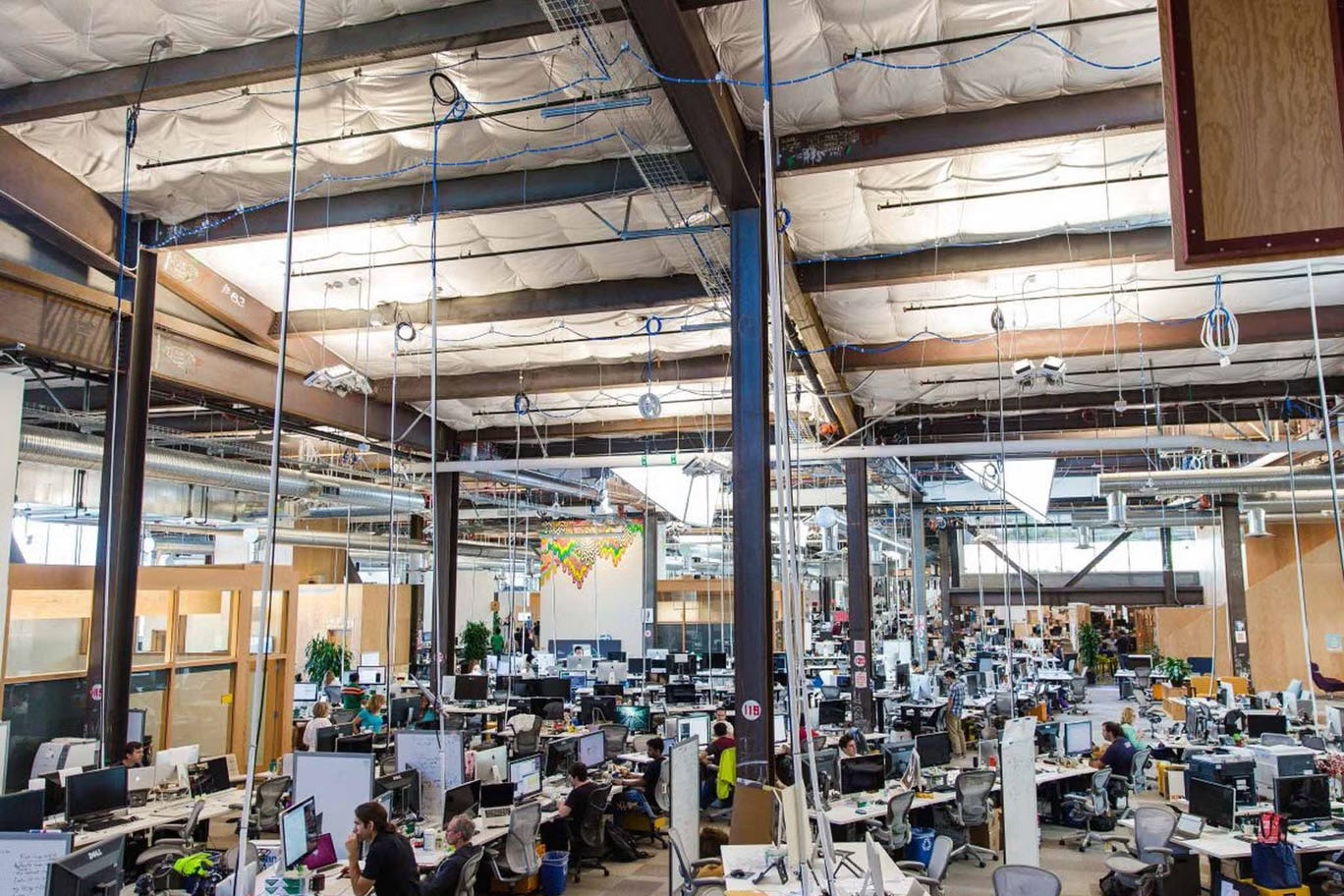
Openness meant transparency. Transparency meant speed. The space itself felt like it was optimized, as if the building could A/B test its own layout. WeWork refined the formula into something even more legible. Exposed brick, eco-futurist phone booths, hot desks for the permanently mobile. For a while, it felt like the future.
But it also started to feel interchangeable. The same office rendered in slightly different brick tones. Same productivity stack. Same standups, same onboarding templates. And now AI compressing even more of it, turning what used to feel like craft into something closer to assembly. When everyone can execute, execution stops being the differentiator. Productivity becomes table stakes.
So what’s left is conviction. And conviction, it turns out, has a spatial logic.
A few patterns keep emerging. The first is zoning. Where the open office optimized for visibility, the new generation of workplaces optimizes for intention.
Dean Levin founded 22RE in Los Angeles with a fairly specific thesis, that the workplace should borrow unashamedly from the grammar of the home. Two recent projects show what that looks like in practice, and they’re different enough to prove the idea has range.
The first is Day Job, a creative agency that operates out of Ed Ruscha’s former studio in Glassell Park. Levin’s brief was to make something “communal and domestic — warm, playful and highly functional, like an elevated extension of working from home.” The conference room was conceived as a bedroom. The lounge as a living room. A sunken piazza at the center of the plan, lit by circular skylights, nods to Italian town squares. Each room tells you what kind of thinking happens inside it.

The second is Ceremony of Roses, a music branding company in Culver City. Same studio, different brief, different vocabulary. 22RE took a 1950s factory and carved it into distinct spatial registers. A huddle room modeled on a 1970s conversation pit, a burl-wood conference room built for structured debate, and a listening room with angled ceilings engineered to reverberate vinyl. Creative director Madeline Denley described the aim as translating “the artist’s purview” into space, “an analogue sensory experience with soft lighting, enveloping textures, and a deep natural palette.” The listening room makes an argument most offices would never dare to make, which is that shared, unhurried attention is worth designing around.

The more surprising version of this argument is happening in typologies where you’d least expect it. And And And Studio’s Century City law office, for a firm that could have defaulted to marble lobbies and power-signaling corner offices, instead traded private office square footage for generous communal areas, briefing the designers to make the space feel closer to a hotel lobby than a law firm. The result layers 1970s Hollywood references with modernist furniture and deep materiality. It’s a workplace that reads as curated and domestic rather than institutional. A law firm making that spatial trade-off is more telling than any creative agency doing the same thing. The stakes are different. The decision means something.

The second pattern is tactility. Velvet, steel, wood, stone. The more abstract our workflows become — and they’re becoming very abstract, very fast — the more grounding we seem to crave. Material pushes back against that abstraction. It says: this is real. We are real. What we’re building exists in the world. If everything digital is infinitely replicable, material becomes proof that something real exists.
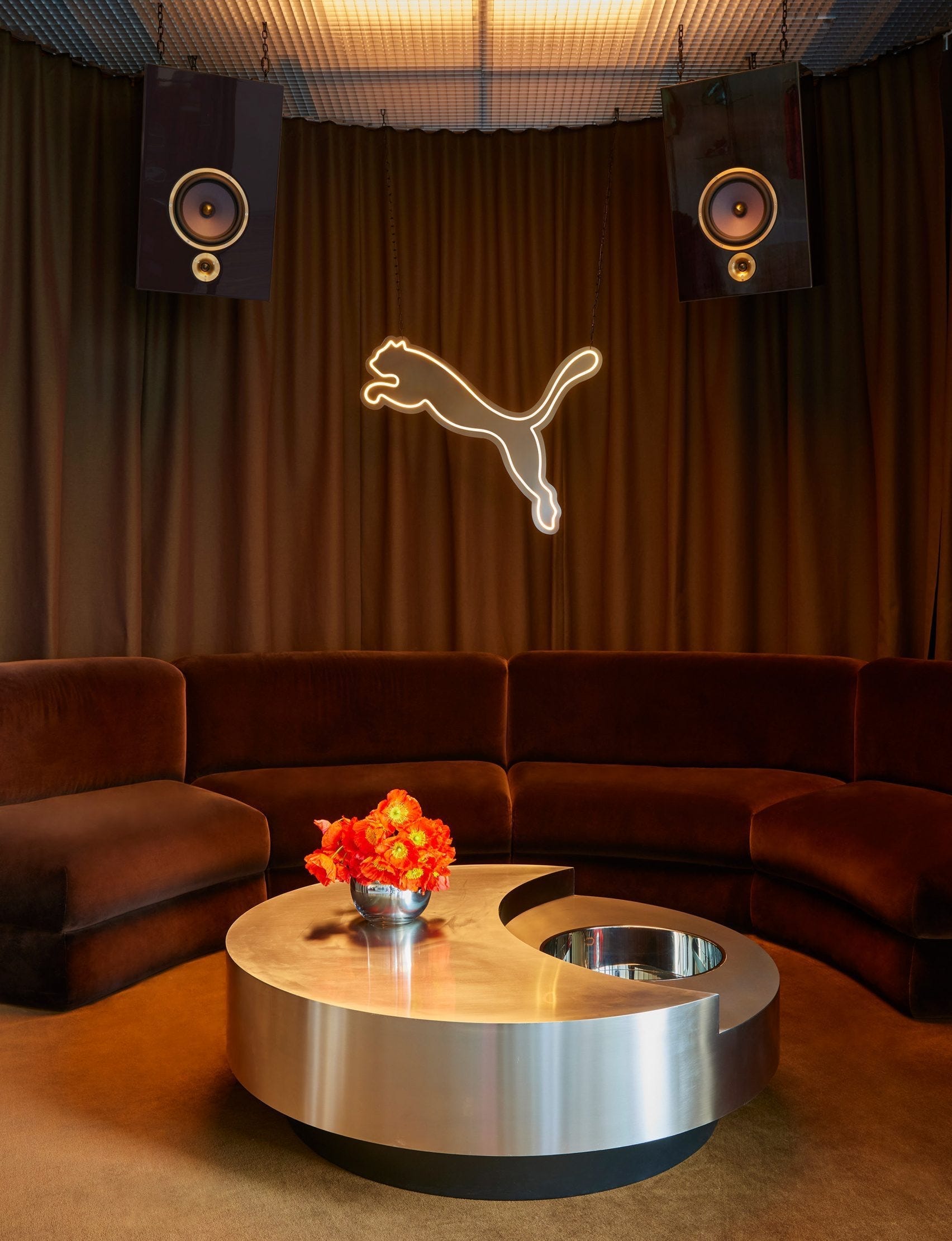
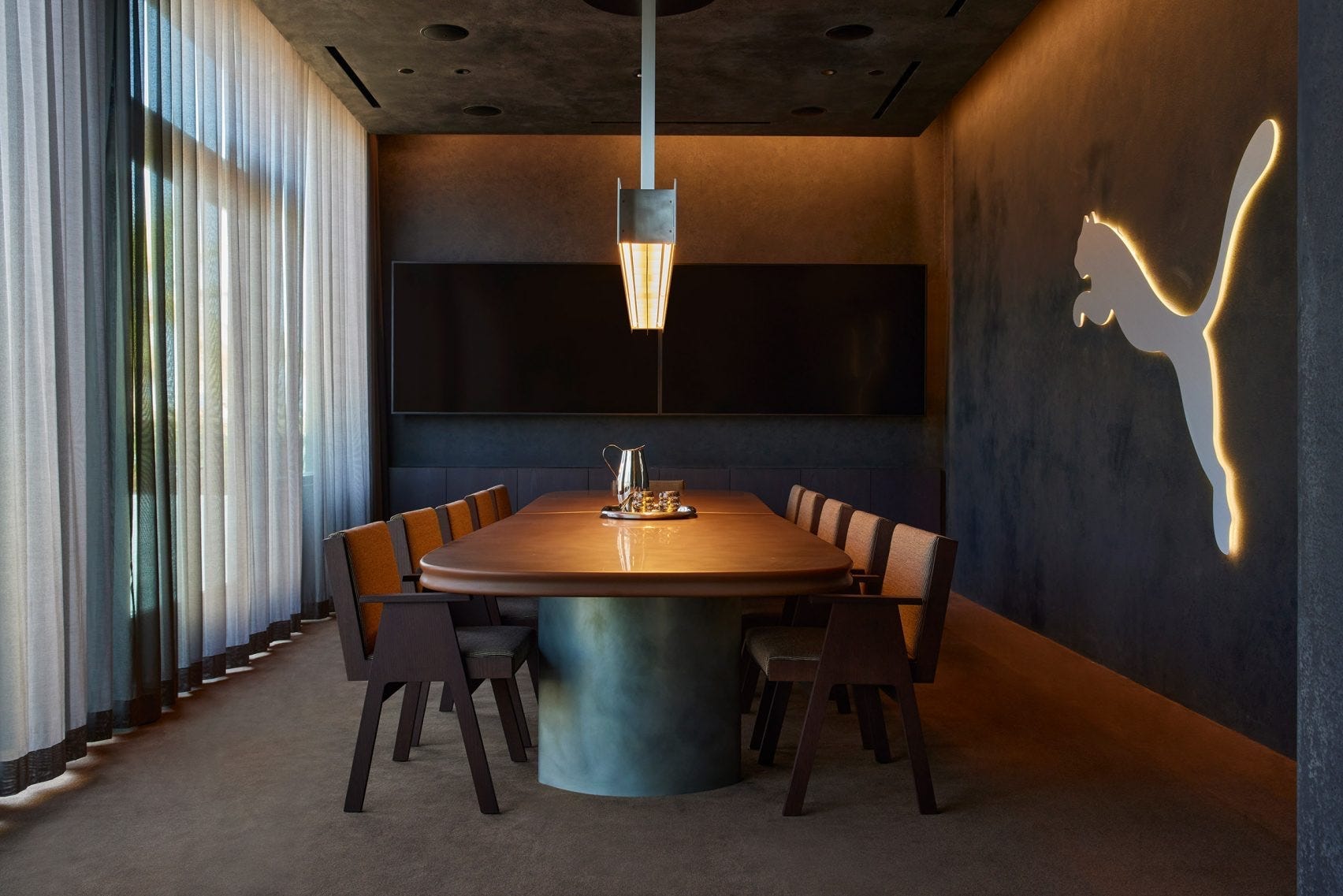
West of West’s Puma Studio in West Hollywood uses fabric as a narrative thread throughout, woven into surfaces, draped across rooms, culminating in a staircase conceived around “the softness of ribbon.” For a company whose entire business is materials, it’s less a design choice than a proof of sincerity. The boardroom makes the same point with its suede plaster walls, sheer curtains, and cast-resin table.
The third pattern is consideration, or what architects might call specificity. To source the right table, commit to a fabric, design a layout that reflects how a company actually thinks rather than how a template suggests it should think. All of that requires taste and some degree of permanence. It requires you to know what you stand for. When I asked Sahil Lavingia, founder of Gumroad and Antiwork about his brief for the new office, the instruction was essentially this: show people they’re working on something that matters. The space becomes an affirmation of belief. Digital is easy to replicate. Physical space isn’t.


The home and the hospitality environment have always been typologies built around belief — conversation, ritual, belonging, the shared idea that certain things are worth doing slowly and with care. The office, at its peak efficiency, shed most of that. What’s happening now isn’t nostalgia for the domestic. It’s a recognition that the spatial grammar of the home was doing something important all along, encoding values into the built environment.
In a world where almost anything can be generated, the hardest thing to generate is conviction. You can execute from anywhere. But you can’t absorb what a company stands for from nowhere. Space has always been one of the primary ways cultures transmit belief, which is why churches are tall, courtrooms are formal, and living rooms are soft. The office is joining that conversation again.
The question every workplace architect is now being asked, whether they know it or not, is the same one that has always defined the best buildings: what does this place say you believe?